Does AI Make Service Effortless, or Just Move the Effort?
Olympia Tsamoura · 9 November 2026. What The Effortless Experience, recent Gartner surveys and field studies of AI in customer service say about customer effort.
In short
- Effort drives disloyalty. In the research behind The Effortless Experience, 96% of customers with high-effort service experiences were disloyal, compared with 9% of those with low-effort ones.
- AI lowers effort only when it resolves the issue or hands over cleanly. Otherwise it moves the effort to the customer. Gartner found that only 14% of service issues are fully resolved in self-service.
- Support agents and measure every journey. The strongest evidence is for AI that helps agents. Effort should be estimated for every journey, not only for customers who answer a survey.
This article brings together three sources: the research in The Effortless Experience (Dixon, Toman and DeLisi, 2013), public Gartner surveys from 2024 to 2026, and field studies of AI in customer service. It covers four questions:
- 1. Does AI reduce customer effort, or move it to the customer?
- 2. Where does AI help, and where does it hurt?
- 3. What happens when AI supports the agent instead of replacing them?
- 4. Can we measure effort on every contact, without a survey?
A note on scope: this is a review of published research, not a new study. The AI figures are from 2024–2026 and may change quickly.
The starting point: effort drives disloyalty
The Effortless Experience is based on surveys of more than 97,000 customers who had recently contacted a company by phone or web. Its main finding is that service interactions rarely build loyalty. The authors report that a service interaction is about four times more likely to make a customer disloyal than loyal. Exceeding expectations brought almost no extra loyalty compared with simply meeting them.
What made the difference was effort. Among customers with high-effort experiences, 96% reported being disloyal. Among those with low-effort experiences, the figure was 9%. The book names the main sources of effort:
- Repeat contacts: the customer has to come back because the issue was not solved. This was the biggest driver.
- Generic service: the customer feels treated like a number.
- Repeating information: for example, after a transfer.
- Perceived effort: how hard the interaction feels, not only how many steps it took.
- Transfers and channel switching: for example, starting online and having to call.
To measure this, the authors propose the Customer Effort Score (CES): a one-question survey sent right after a service contact. In version 2.0, the customer says how much they agree with the statement “The company made it easy for me to handle my issue”, from 1 (strongly disagree) to 7 (strongly agree). A higher score means less effort. The first version asked how much effort the customer had to put in, on a 1–5 scale. The authors changed it because there a low score meant a good result, which confused customers. In their data, CES 2.0 was 12% more predictive of loyalty than CSAT.
The book was written in 2013, before generative AI. Its effort drivers, though, describe exactly the risks of a badly designed chatbot.
1. Does AI reduce effort, or move it to the customer?
The evidence so far says: often it moves it. A contact the bot “contains” counts as a success for the company, even if the customer gives up, comes back later or calls another way.
What customers say. In a Gartner survey of 5,728 customers (December 2023), 64% said they would prefer companies not to use AI for customer service. Their top concern (60%) was that AI would make it harder to reach a person. 42% worried about wrong answers, and 53% said they would consider switching to a competitor if they found out a company was going to use AI for customer service. (Gartner, July 2024)
Two years later. A newer Gartner survey of 3,566 customers (February–March 2026) shows more openness, with a clear condition. 50% said their interactions are easier when companies use generative AI, but 87% said an option to reach a human agent is essential. Only 27% would try a chatbot again after a negative experience. And while 49% said they would have used a chatbot, only 7% actually did in their last service contact. The 2023 and 2026 surveys asked different questions, so their figures are not directly comparable. (Gartner, August 2026, Gartner, September 2026)
What happens in self-service. In a Gartner survey of 5,728 customers, only 14% of issues were fully resolved in self-service. For issues customers called “very simple”, it was only 36%. 45% of those who started in self-service said the company did not understand what they were trying to do. (Gartner, August 2024)
Read through the book’s lens, these are familiar effort drivers. A bot that does not solve the issue creates a repeat contact. A customer who gives up and calls is channel switching. An agent who asks again for what the bot already collected makes the customer repeat information.
The book also found that customers do not want endless choice. 84% wanted their issue solved quickly and were happy to be guided to the best option. That is good news for AI: a bot that guides well fits what customers want. A bot that blocks the way to a person does not.
A public example. In February 2024, Klarna said its AI assistant was doing the work of 700 full-time agents (Klarna). By May 2025 it was hiring human agents again, after its CEO said the focus on cost had lowered quality (CX Dive). By mid-2026 it ran a hybrid model, with a specialist human team for complex and sensitive cases (Forbes).
The industry seems to be adjusting. Gartner predicts that by 2027, half of the organizations that planned to cut their service workforce because of AI will drop those plans. (Gartner, June 2025)
2. Where AI helps and where it hurts
AI lowers effort most for simple issues with low stakes. It raises effort most when it stands between a person with a complex, stressful problem and someone who can help. The framework below is my own synthesis of the sources, not a tested model.
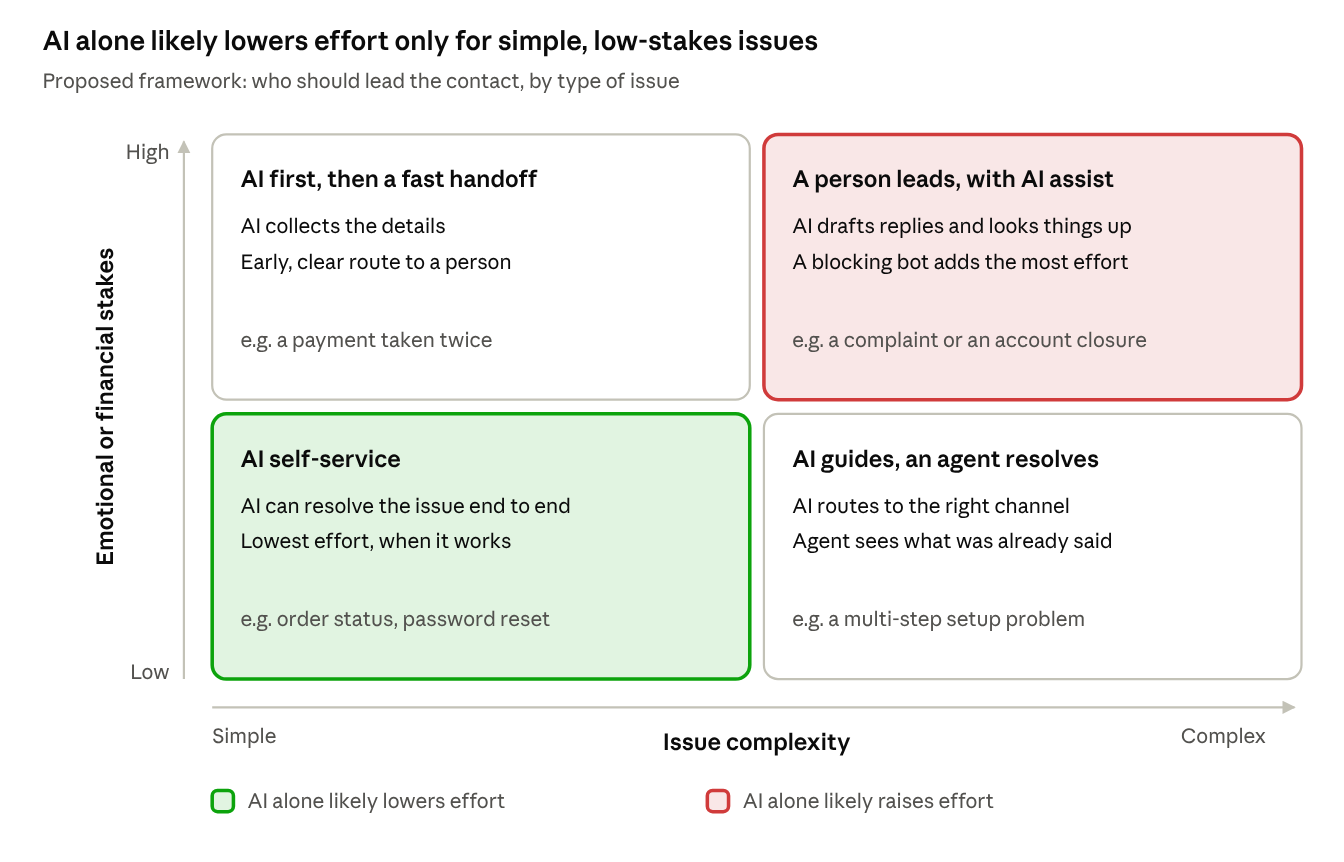
Figure 1. AI and effort: a 2x2 by issue complexity and stakes. AI alone likely lowers effort only for simple, low-stakes issues.
The two axes come from the research. Gartner found that self-service fully resolved only 36% of even “very simple” issues, and 14% of issues overall. The book found that generic service drives repeat contacts, especially when a customer wants empathy or ownership and gets a corporate answer. A scripted bot is most likely to give that answer in stressful cases.
The practical test for any AI journey is simple: does it end with the issue resolved, or with a clean handoff where the customer does not repeat themselves? If neither, the bot has only moved the effort.
3. AI for the agent, not only for the customer
The strongest evidence for AI in service comes from tools that support agents rather than replace them. The best-known study is “Generative AI at Work” by Brynjolfsson, Li and Raymond, published in the Quarterly Journal of Economics in 2025. It followed 5,172 support agents at a software company as an AI assistant suggested replies in real time. (QJE, open access)
The main results:
- Issues resolved per hour rose by 15% on average, and by 36% for the least-skilled agents.
- Agents with two months of tenure and AI performed as well as agents with more than six months without it.
- Customers were more polite, and requests to speak to a manager fell by almost 25%.
- The most skilled agents saw no significant productivity gain, and small drops in resolution rates and customer satisfaction.
This links back to the book in three ways:
- 1. Less generic service. The AI was trained with extra weight on chats by top-performing agents, to pick up habits such as asking clarifying questions. That is the opposite of a template answer.
- 2. Fewer escalations. Fewer requests for a manager likely means fewer escalations and less repeating information. (The study measured requests, not actual transfers.)
- 3. Room for judgment. The book argues the most important agent skill is the “control quotient”: using judgment and staying in control in complex cases. If AI handles lookup and drafting, agents can spend more time on that.
The book’s idea of next issue avoidance is another strong use case. It means the agent solves today’s issue and also warns the customer about the problem likely to come next. The authors found that many repeat contacts come from issues the customer had not raised yet: 22% from adjacent issues and 24% from emotional doubts about the answer.
An AI assistant could make this easier by suggesting the likely next question during the contact. I have not found published results that test this directly, so it remains a hypothesis.
Newer studies add a caution. Two more recent field experiments show that faster, friendlier service is not the same as less effort:
- At Alibaba, 5,940 new chat agents were randomly split, and about half got an AI assistant that drafted a diagnosis and solution at the start of each chat. Service got faster and customer ratings rose slightly, but the share of customers who came back with the same issue within three days did not change (it stayed at about 39%). For the agents with the best ratings before the experiment, AI made both ratings and repeat contacts worse. This is a working paper that has not yet been peer-reviewed. (Ni et al., SSRN)
- At a meal-delivery company, AI assistance helped most in cancellation chats and least with repeat complaints. For customers whose issue a chatbot had failed to understand, AI assistance in the following human chat had a negative effect on sentiment. (Zhang and Narayandas, Management Science, 2026)
In the book’s terms: ratings can rise while repeat contacts, the biggest effort driver, stay the same. And effort from a failed bot carries over into the human part of the journey.
Gartner’s advice points the same way: use AI to support agents and redeploy them to complex, high-value contacts, not to remove them. (Gartner, September 2025)
4. Predicted CES: measuring effort on every contact
A CES survey only covers the customers who answer it, and AI makes this gap bigger. A customer who quits the bot halfway may never receive a survey, yet that may be the highest-effort journey of the day. A predicted CES estimates effort for every contact from what the customer actually did. This section is a proposed method, not a tested result.
The idea is already in the book. The authors present CES as one indicator among several and recommend checking it against operational data on the whole journey. They also warn that a company’s own data can miss what customers count as effort: a customer who starts in chat and then calls sees that as a transfer, even if the phone system does not.
Signals that can be measured from journey data
| Effort driver (book) | Signal from data | Typical source |
|---|---|---|
| Repeat contact | Same customer, same topic, within X days | CRM / ticket history |
| Channel switching | Bot or web session followed by call, chat or email | Web analytics + contact logs |
| Transfers | Bot-to-agent handoff, agent-to-agent transfer | Contact platform |
| Repeating information | Agent asks for data the bot already collected | Transcripts (text classification) |
| Perceived effort | Rephrased questions, “agent please”, negative tone | Bot and chat transcripts |
| Abandonment | Bot session ends with no resolution and no handoff | Bot logs |
The “X days” window and the topic matching need to be set per business; there is no universal value.
How a model could work, in plain terms
Only a small group of customers answer the CES survey. For them we know two things: the score they gave, and what happened in their journey (did they call back, switch channel, get transferred). A model learns the link between the two. We then use that link to estimate a score for every customer who did not answer.
Example: suppose most customers who tried the chatbot, then called, then called again gave a score of about 2 out of 7. A new customer with the same path but no survey answer would get an estimated score close to 2.
The steps:
- 1. Group contacts into journeys. All contacts about the same issue form one journey, because effort builds up across contacts.
- 2. Learn from surveyed journeys. Journeys with a CES answer are the examples the model learns from.
- 3. Check the guesses. Keep some surveyed journeys aside, let the model estimate their score, and compare with the real answers.
- 4. Estimate for everyone. If the check is good enough, apply the model to all journeys, including those with no survey.
- 5. Look at the spread, not only the average. Count how many journeys are high-effort. The book warns that a good average can hide a group of very hard journeys.
Limits to keep in mind
- Survey answers are not a random sample. Customers who answer may differ from those who don’t, so the model can inherit that bias.
- Transcript signals depend on language and on the quality of text classification, which should be checked by hand on a sample.
- A predicted score is an estimate. It should guide where to look, not replace asking customers.
- Transcripts contain personal data, so privacy rules (such as GDPR in the EU) apply.
What this means for CX leaders
The goal of AI in service should be the same as the goal the book set in 2013: less effort for the customer, not fewer contacts for the company. In practice:
- 1. Measure resolution, not containment. Track whether the issue was solved across the whole journey, including later calls and emails.
- 2. Always offer a clear way to a person. Customers’ top fear about AI is losing that path. When the bot hands over, the agent should see what the customer already said.
- 3. Guide, don’t block. Customers accept being steered to the best channel. Use AI to route simple issues to self-service and complex or emotional ones to people early.
- 4. Invest in agent assist. It has the strongest published evidence, especially for new agents. Track repeat contacts as well as ratings, because the two can move differently.
- 5. Measure effort on every journey. Keep the CES 2.0 survey, and add a predicted effort score so silent drop-outs are not invisible.
Limits of this review. It relies on one 2013 book, mostly surveys from one research firm (Gartner, and CEB, which Gartner later acquired), and three field studies of AI in customer service. The best-known one used a GPT-3-based tool rolled out in 2020–2021, and one is a working paper that has not yet been peer-reviewed. Today’s AI tools are more capable, so older results may not carry over directly. The AI landscape changes fast, and figures from 2024–2026 may already be out of date. Studies that measure customer effort directly in AI-led journeys are still rare.
Sources
Dixon, M., Toman, N. and DeLisi, R. (2013). The Effortless Experience: Conquering the New Battleground for Customer Loyalty. Portfolio/Penguin. (Research by CEB, later acquired by Gartner.)
Brynjolfsson, E., Li, D. and Raymond, L. (2025). “Generative AI at Work.” Quarterly Journal of Economics 140(2), 889–942. doi.org/10.1093/qje/qjae044 (open access)
Ni, X., Wang, Y., Feng, T., Lu, L. X., Wang, Y. and Zhou, C. “Generative AI in Action: Field Experimental Evidence from Alibaba’s Customer Service Operations.” Working paper, SSRN, revised July 2026. papers.ssrn.com/abstract=5012601
Zhang, S. and Narayandas, D. (2026). “Engaging Customers with AI in Online Chats: Evidence from a Randomized Field Experiment.” Management Science 72(1), 73–95. Summary by Harvard Business School
Gartner (9 July 2024). Survey finds 64% of customers would prefer that companies didn’t use AI for customer service
Gartner (19 August 2024). Survey finds only 14% of customer service issues are fully resolved in self-service
Gartner (10 June 2025). Predicts 50% of organizations will abandon plans to reduce customer service workforce due to AI
Gartner (10 September 2025). Predicts none of the Fortune 500 companies will have fully eliminated human customer service by 2028
Gartner (4 August 2026). Survey finds 87% of customers say companies using GenAI for customer service must provide access to a human agent
Gartner (2 September 2026). Survey finds only 27% of customers would try a chatbot again after a negative experience
Klarna (27 February 2024). Klarna AI assistant handles two-thirds of customer service chats in its first month
CX Dive (May 2025). Klarna changes its AI tune and again recruits humans for customer service
Marr, B. (16 July 2026). How Klarna’s AI agent strategy backfired but became a useful lesson. Forbes.